
Japanese tin toys from the mid-20th century hold a special place for many collectors. They were often innovative, colourful, and well-made. However, the popularity of these originals has led to a market for reproductions, particularly from China, which started appearing in the 1980s and continue today. It can be tricky to tell the difference if you don’t know what to look for.
Here at The Forgotten Toys, we’ve handled countless tin toys over the years. We want to share some straightforward tips to help you identify genuine vintage Japanese pieces from later copies. It is not always about one single sign; often, it is a combination of clues.
Look at the overall quality and finish
Original Japanese tin toys, especially those made from the 1950s to the 1970s, generally show a good standard of craftsmanship. The lithography, the artwork printed onto the tin, is usually crisp and detailed. Colours are often vibrant and well-aligned. You will see subtle shading and fine lines.
Reproductions often have a slightly cruder finish. The colours might be flatter, and the lithography can appear blurry or less precise, almost as if it’s a photocopy of an original. Sometimes the colours are too bright or not quite right compared to period examples. The paint might also feel thicker or more plastic-like on newer items.
Another detail is the metal itself. Vintage Japanese tin often has a certain weight and feel. Reproductions can sometimes feel lighter or less substantial. Pay attention to the edges and seams; older pieces often have carefully folded or crimped edges, whereas some reproductions might have sharper, less refined joins.
Check for maker’s marks and country of origin
This is one of the most reliable indicators. Most legitimate Japanese tin toys will have a maker’s mark. Common Japanese makers include Yonezawa (Y), Bandai, Masudaya (MT, for Modern Toys), Nomura (TN), and Alps. These marks are usually stamped or lithographed onto the toy, often on the base, side, or battery compartment cover.
Crucially, they will almost always state ‘Made in Japan’ or ‘Made in Occupied Japan’ (for earlier pieces, roughly 1945-1952). If you see ‘Made in China’, you are looking at a later piece. No country mark at all is less conclusive: some genuine Japanese toys only carried the mark on the box, so treat it as a reason to look harder rather than proof. Some reproductions try to copy the Japanese marks, but they might be slightly off in design or placement. Always check for clarity and authenticity.
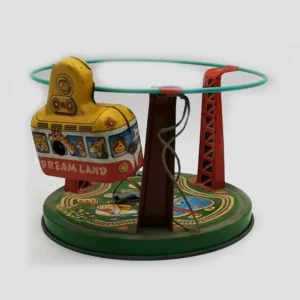
The Playland cable car in our shop is a good example: it carries the T.P.S. maker’s mark and the words “Made in Japan”, which is the first thing we check.
Examine the construction and materials
Vintage Japanese tin toys often used mechanisms that are visible or clearly part of the toy’s design. Think about wind-up keys, exposed gears, or battery compartments with simple, sturdy closures. The plastic parts, if any, on older toys tend to be a harder, more brittle plastic, not the softer, more flexible plastics common today.
Reproductions sometimes use cheaper, more modern plastics for details or mechanisms. Screws are another good clue. Older Japanese toys often used simple, unpainted metal screws. Many vintage pieces were held together with folded metal tabs rather than screws at all, so a toy full of modern cross-head screws deserves a closer look.
Also, consider how the toy moves or operates. Wind-up mechanisms on vintage toys tend to feel smoother, even after decades, if they have been cared for. Reproductions might have stiffer or less reliable mechanisms.
Look at the packaging and accessories
While many vintage toys no longer have their original boxes, if you do encounter one, it can offer clues. Original Japanese toy boxes often feature distinctive graphics and Japanese text alongside English. The cardboard quality might also differ. Reproductions sometimes come in boxes that look too new, or have printing that feels slightly off. Artwork might be scanned and therefore less sharp.
Any accessories, like antennae or small plastic parts, should match the quality and style of the main toy. Loose or poorly fitting accessories can be a red flag for a reproduction.
Ultimately, familiarity helps. The more vintage tin toys you see, the better you will become at spotting the genuine articles. Handle them, look closely at the details, and trust your instincts. Always buy from reputable sellers who understand the difference.
You can find a selection of vintage tin toys and other collectables in our shop and at upcoming auctions.